


Many people think of Parkinson’s disease as a condition that only affects older adults. However, Parkinson’s can start young, and young-onset Parkinson’s disease generally refers to Parkinson’s diagnosed before age 50. Although it is less common than later-onset disease, younger adults can experience many of the same movement and non-movement symptoms.
At the same time, a tremor, stiffness, fatigue, constipation, sleep problem, or change in handwriting does not automatically mean Parkinson’s. Several neurological, medication-related, metabolic, and thyroid-related conditions can cause similar complaints. Therefore, recognizing a pattern of persistent or progressive symptoms is more useful than trying to diagnose yourself from a checklist.
This guide explains the possible early signs of young-onset Parkinson’s, how thyroid disorders can overlap with some symptoms, and when professional evaluation becomes important.
What Is Parkinson’s Disease?
Parkinson’s disease is a progressive neurological disorder that affects movement as well as several functions outside the motor system. The disease involves changes and loss of nerve cells in an area of the brain called the substantia nigra. These cells produce dopamine, a chemical messenger that helps the brain coordinate smooth, purposeful movement.
As dopamine-producing cells are affected, movement can become slower or less coordinated. Consequently, people may develop symptoms such as tremor, stiffness, and changes in walking or balance.
However, Parkinson’s is not simply a “shaking disease.” Non-motor symptoms can also occur. These may include constipation, sleep disturbances, mood changes, changes in thinking, and other problems involving the autonomic nervous system.
Because symptoms vary considerably, doctors look at the overall pattern rather than relying on one symptom.
Can Parkinson’s Start Young? Understanding Young-Onset Parkinson’s
Young-onset Parkinson’s, also called early-onset Parkinson’s, generally means Parkinson’s disease diagnosed before age 50. Most people with typical Parkinson’s develop symptoms at 50 or later.
Understanding that Parkinson’s can start young is important because early symptoms may initially be mistaken for stress, fatigue, medication effects, or other health conditions.
Young-onset Parkinson’s shares many features with later-onset disease. Nevertheless, age at diagnosis can influence treatment planning and the practical challenges a person faces.
For example, someone diagnosed in their 30s or 40s may still be building a career, raising children, managing a mortgage, or planning long-term finances. In addition, younger people with Parkinson’s may have a greater likelihood of a family history or genetic contribution, so clinicians may consider genetic counseling in selected cases.
Importantly, being young and experiencing a tremor does not mean a person has young-onset Parkinson’s. A proper medical assessment remains essential.
Parkinson’s Can Start Young: Early Signs to Know
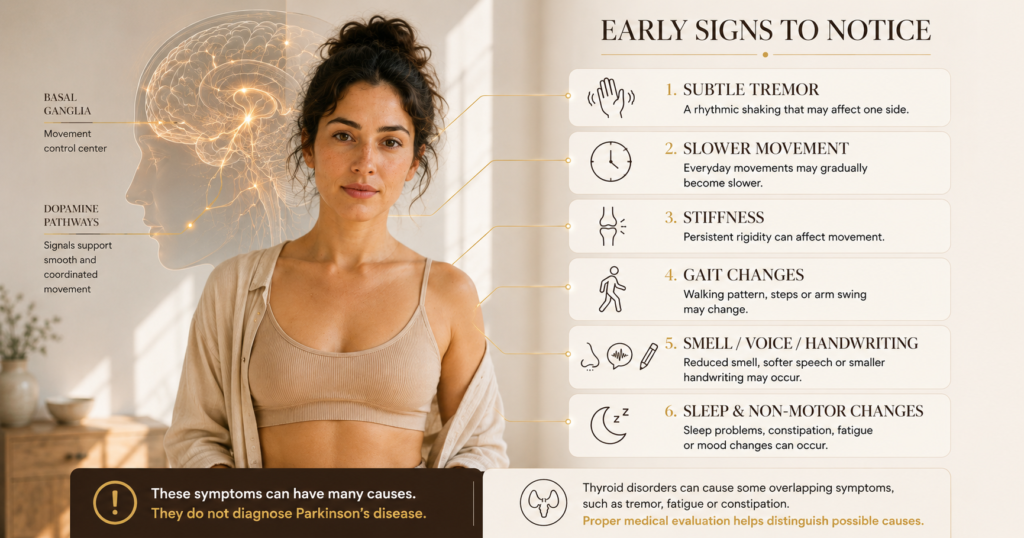
The early symptoms of Parkinson’s can be subtle. Furthermore, some may appear gradually rather than all at once. Because Parkinson’s can start young, persistent changes in movement deserve attention even when someone is well below the typical age associated with Parkinson’s disease.
1. Subtle Tremor
A tremor is an involuntary rhythmic movement. In Parkinson’s, tremor may affect a hand, arm, leg, jaw, or face. However, the exact pattern can differ between people, particularly in young-onset disease.
A tremor by itself is not enough to diagnose Parkinson’s. Essential tremor, certain medicines, anxiety, thyroid disorders, caffeine, and other conditions can also produce shaking.
Therefore, pay attention to persistence, pattern, and whether the tremor occurs alongside other changes in movement.
2. Slower Movement
Another important Parkinson’s neurological symptom is bradykinesia, which means slowness of movement.
This can be more than simply feeling tired or moving slowly after a long day. Instead, a person may notice that familiar tasks gradually take longer. For example, buttoning clothes, typing, writing, getting out of a chair, or performing repetitive hand movements may become noticeably slower.
Moreover, reduced movement can sometimes appear on one side of the body before becoming more widespread.
3. Stiffness or Rigidity
Muscle stiffness can occur in Parkinson’s and may affect the arms, legs, neck, or trunk. Unlike ordinary soreness after exercise, Parkinsonian rigidity reflects increased resistance to movement around a joint.
However, stiffness has many possible explanations. Muscle strain, arthritis, medication effects, neurological conditions, and other problems can produce similar sensations.
Consequently, persistent stiffness becomes more meaningful when it occurs with other neurological changes.
4. Changes in Walking and Coordination
Changes in gait can include smaller steps, reduced arm swing, difficulty turning, or a noticeable change in walking rhythm.
Balance and coordination can also change. However, significant balance problems are not necessarily an early feature of typical Parkinson’s, so prominent or rapidly developing gait problems deserve careful medical assessment for other causes as well.
5. Reduced Sense of Smell
A reduced sense of smell, known as hyposmia, can occur in Parkinson’s and may sometimes appear before more obvious movement symptoms.
Nevertheless, loss of smell is highly nonspecific. Respiratory infections, nasal conditions, aging, medications, and other neurological conditions can affect smell.
For that reason, loss of smell alone should never be treated as proof of Parkinson’s.
6. Voice and Handwriting Changes
Some people develop a softer voice, less expressive speech, or other changes in communication.
Similarly, handwriting can become smaller or more cramped. This is sometimes called micrographia.
These changes may be easy to overlook because people often adapt gradually. Therefore, comparing older handwriting samples or noticing repeated comments from family members about a quieter voice can sometimes help identify a change worth discussing with a clinician.
7. Sleep and Other Non-Motor Symptoms
Parkinson’s can also involve symptoms that have nothing to do with shaking or walking.
Examples include:
- Sleep disturbances
- Constipation
- Fatigue
- Depression or anxiety
- Changes in thinking or memory
- Urinary symptoms
Some non-motor symptoms can precede motor symptoms. However, they are common in many unrelated health conditions, so they have limited diagnostic value on their own.
Can Thyroid Disease Cause Parkinson-Like Symptoms?
The fact that Parkinson’s can start young does not mean that every tremor or movement change in a younger adult represents Parkinson’s disease.
This is an important question because thyroid disease and Parkinson’s can share some symptoms, even though they are different medical conditions.
For example, hyperthyroidism can cause hand tremor, anxiety, palpitations, difficulty sleeping, muscle weakness, and changes in energy levels.
In contrast, hypothyroidism can cause tiredness, constipation, feeling cold, low mood, and problems with memory or concentration.
Therefore, someone experiencing fatigue, tremor, constipation, sleep problems, or changes in movement should not automatically assume that Parkinson’s is responsible.
Interestingly, researchers have also investigated whether thyroid dysfunction is associated with Parkinson’s disease. A 2022 systematic review and meta-analysis reported an association between both hypothyroidism and hyperthyroidism and Parkinson’s disease. However, an association does not establish that thyroid disease causes Parkinson’s disease.
In other words, thyroid disease is not another name for Parkinson’s, and treating a thyroid disorder should not be presented as a treatment for Parkinson’s.
Instead, doctors may consider thyroid testing and other investigations when symptoms could have more than one explanation.
Parkinson’s Can Start Young: What Women Should Know
Research increasingly recognizes differences between women and men with Parkinson’s disease.
Studies have reported differences in clinical features, non-motor symptoms, treatment response, complications, and disease progression. Hormonal and reproductive factors are also being investigated.
More recent research continues to examine Parkinson’s across reproductive stages, including menstruation, pregnancy, and menopause. However, researchers emphasize that available evidence remains limited and heterogeneous.
Therefore, it would be inaccurate to claim that low estrogen, menopause, or another hormonal change directly causes Parkinson’s.
Instead, hormonal and reproductive factors represent an important area of ongoing research that may eventually help clinicians better individualize care.
These Symptoms Do Not Automatically Mean Parkinson’s
One of the most important messages is simple: symptoms are clues, not a diagnosis.
Tremor, stiffness, fatigue, constipation, sleep problems, reduced smell, and movement changes can have many causes.
Depending on the symptoms, clinicians may consider possibilities such as:
- Thyroid disorders
- Medication side effects
- Essential tremor
- Other movement disorders
- Neurological conditions
- Sleep disorders
- Nutritional or metabolic problems
- Anxiety and other health conditions
Some medicines can also produce Parkinson-like movement symptoms. Therefore, reviewing current medications with a healthcare professional can be an important part of evaluation.
When Should You Seek Medical Advice?
Consider speaking with a healthcare professional if a neurological symptom is persistent, progressive, repeatedly occurring, or beginning to interfere with everyday activities.
For example, medical evaluation may be appropriate when you notice:
- A persistent unexplained tremor
- Increasing stiffness
- Progressive slowing of movement
- New handwriting or voice changes
- Repeated changes in walking or coordination
- A combination of motor and non-motor symptoms
- Symptoms that are interfering with work or daily life
You do not need to wait until several symptoms appear before discussing a concerning change with a doctor.
Furthermore, keeping a simple record of when symptoms started, how often they occur, which side is affected, and whether they are getting worse can help during a consultation.
How Is Young-Onset Parkinson’s Diagnosed?
There is no single routine blood test that definitively diagnoses Parkinson’s disease.
Instead, clinicians primarily use a person’s medical history and neurological examination. They assess movement patterns, tremor, rigidity, slowness, coordination, medication history, symptom progression, and possible alternative explanations.
Depending on the situation, doctors may use blood tests, imaging, or specialized investigations to rule out other conditions or support the diagnostic process. A DaTscan, for example, can help evaluate dopamine transporter activity in selected cases, but it cannot by itself distinguish Parkinson’s disease from every other form of parkinsonism.
Therefore, diagnosis should be made by an appropriately qualified healthcare professional rather than through an online symptom checklist.
Treatment and Support for Young-Onset Parkinson’s
If a person receives a diagnosis, treatment is individualized.
Management may involve medicines, physical therapy, occupational therapy, speech therapy, exercise, and other supportive approaches. Treatment planning can also consider employment, family responsibilities, long-term quality of life, and medication-related complications.
Young-onset Parkinson’s may have some differences from later-onset disease. For example, the Parkinson’s Foundation notes that younger people may experience slower progression but can have medication-related movement complications such as dyskinesias and dystonias.
Consequently, long-term follow-up with an appropriate healthcare team is important.
Parkinson’s in Younger Adults: Common Myths
Myth: Parkinson’s only affects older adults.
Fact: Young-onset Parkinson’s can occur before age 50.
Myth: A hand tremor means Parkinson’s.
Fact: Tremor has many possible causes, including essential tremor, medications, and thyroid disorders.
Myth: Loss of smell means you have Parkinson’s.
Fact: Reduced smell can occur in Parkinson’s, but many other conditions can affect the sense of smell.
Myth: Thyroid disease and Parkinson’s are the same condition.
Fact: They are separate disorders, although some symptoms can overlap.
Myth: An internet symptom checklist can diagnose Parkinson’s.
Fact: Parkinson’s diagnosis relies primarily on clinical assessment and neurological examination.
Frequently Asked Questions
Can Parkinson’s start before age 40?
Yes. Young-onset Parkinson’s is generally defined as Parkinson’s diagnosed before age 50, so diagnosis can occur in someone in their 30s or 40s. However, Parkinson’s remains uncommon in younger adults, and symptoms such as tremor or stiffness have many other possible explanations.
What are the first signs of Parkinson’s?
Possible early signs include tremor, slowness of movement, stiffness, changes in handwriting or voice, reduced sense of smell, and certain sleep or other non-motor symptoms. However, these symptoms are not specific to Parkinson’s and require clinical context.
Can a young person have Parkinson’s?
Yes. Young-onset Parkinson’s occurs in people diagnosed before age 50. It shares many symptoms with typical Parkinson’s, although the course, treatment considerations, and life circumstances can differ.
Can thyroid disease cause Parkinson-like symptoms?
Thyroid disorders can cause symptoms that overlap with Parkinsonian complaints. Hyperthyroidism, for instance, can cause hand tremor and sleep difficulties, while hypothyroidism can cause fatigue and constipation. However, thyroid disease and Parkinson’s are distinct conditions.
Does a tremor always mean Parkinson’s?
No. Tremor can occur with essential tremor, thyroid disorders, medications, anxiety, caffeine use, and several neurological conditions. The pattern, timing, associated symptoms, medical history, and examination all matter.
When should I see a doctor about possible Parkinson’s symptoms?
Consider medical advice when symptoms persist, worsen, recur, or interfere with daily activities. A clinician can assess whether the symptoms suggest Parkinson’s, another neurological condition, a medication effect, a thyroid disorder, or another cause.
Final Takeaway
Parkinson’s can start young, but recognizing this possibility should create awareness—not fear.
A tremor, stiffness, reduced sense of smell, constipation, sleep disturbance, or change in handwriting does not automatically mean Parkinson’s. Instead, persistent or progressive symptoms deserve appropriate medical attention so that possible causes can be evaluated carefully.
This is particularly important when thyroid disease is also a possibility because thyroid disorders can produce symptoms that overlap with neurological conditions. At the same time, current research on thyroid dysfunction and Parkinson’s shows association rather than proof of causation.
Ultimately, early awareness is valuable, but self-diagnosis is not. If something about your movement, coordination, sleep, smell, voice, or other neurological function is changing and the change persists, speak with a qualified healthcare professional.
Medical Disclaimer
This article is intended for general health education and awareness. It does not diagnose or treat Parkinson’s disease, thyroid disease, or any other medical condition, and it should not replace an assessment or advice from a qualified healthcare professional.