

Introduction
Thyroid diseases can affect the body in different ways, from changing energy levels and metabolism to affecting heart rate, body temperature, digestion, and other important functions. The thyroid is a small, butterfly-shaped gland at the front of the neck that produces the hormones thyroxine (T4) and triiodothyronine (T3).
There isn’t just one type of thyroid problem. Some conditions cause too little thyroid hormone, while others cause too much. Other thyroid disorders can enlarge the gland, create nodules, cause inflammation, or result from autoimmune changes.
Symptoms can also be confusing. Fatigue, weight changes, changes in body temperature, bowel changes, anxiety, and heart-rate changes can occur with thyroid disorders, but they can also have many other causes.
So, how do you know what deserves attention?
Understanding the different types of thyroid diseases—and recognizing persistent or concerning changes—can help you know when it may be appropriate to speak with a healthcare professional.
What Does the Thyroid Gland Do?
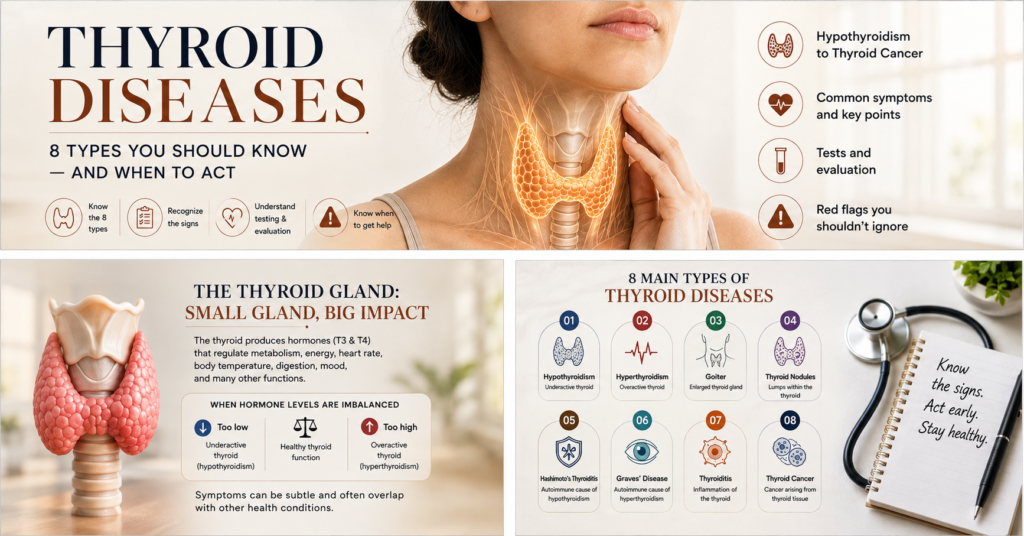
The thyroid sits in the lower front part of the neck and produces T4 and T3. These hormones help regulate metabolism, meaning how the body uses energy. They also influence functions such as heart rate, digestion and body temperature.
The thyroid does not work alone. The pituitary gland produces thyroid-stimulating hormone (TSH), which signals the thyroid to produce thyroid hormones.
When thyroid hormone activity is too low, the condition is generally called hypothyroidism. When hormone activity is too high, it is called hyperthyroidism.
But thyroid disorders can also affect the structure of the gland itself. Goiters involve enlargement, while thyroid nodules are localized growths. Autoimmune conditions such as Hashimoto’s disease and Graves’ disease can alter thyroid function, and thyroiditis involves inflammation.
Here are eight important thyroid conditions worth knowing about.
1. Hypothyroidism
Hypothyroidism, or an underactive thyroid, occurs when the thyroid does not provide enough thyroid hormone for the body’s needs.
The condition may develop gradually, so changes can sometimes be easy to overlook. Possible symptoms include:
- Fatigue
- Feeling unusually cold
- Weight gain
- Constipation
- Dry skin
- Slower-than-usual heart rate
- Dry or thinning hair
- Difficulty concentrating
- Changes in menstrual patterns
These symptoms are not unique to hypothyroidism. For example, tiredness and weight changes can have many possible explanations.
One important cause is Hashimoto’s disease, an autoimmune condition in which the immune system attacks thyroid tissue. Other causes can include certain treatments, medications and other thyroid disorders.
When hypothyroidism is suspected, healthcare professionals commonly use thyroid blood tests, particularly TSH and T4, as part of the evaluation.
2. Hyperthyroidism
Hyperthyroidism occurs when the thyroid produces too much thyroid hormone.
Because thyroid hormones influence metabolism and many body functions, excess hormone activity can make several processes become more active.
Possible symptoms include:
- Unintentional weight loss
- Fast or irregular heartbeat
- Heat intolerance
- Tremor
- Increased sweating
- Anxiety or restlessness
- Difficulty sleeping
- Muscle weakness
- More frequent bowel movements
One of the most common causes of hyperthyroidism is Graves’ disease, an autoimmune disorder. Other causes include overactive thyroid nodules and some forms of thyroiditis.
Persistent palpitations should not automatically be blamed on the thyroid. Heart-rhythm symptoms can have several causes and deserve appropriate medical assessment, particularly when they are significant or persistent.
3. Goiter
A goiter is an enlarged thyroid gland.
A goiter does not automatically mean that someone has cancer. Thyroid enlargement can occur in people with normal thyroid function as well as in people with hypothyroidism or hyperthyroidism.
Depending on its size and cause, a goiter may be associated with:
- Visible enlargement at the front of the neck
- A feeling of fullness in the neck
- Pressure or tightness
- Difficulty swallowing
- Breathing discomfort in some cases
A new or enlarging swelling in the neck should be evaluated rather than self-diagnosed.
The cause of the enlargement determines what investigations may be appropriate.
4. Thyroid Nodules
Thyroid nodules are localized lumps or growths within the thyroid gland. They are common, and most are benign. The American Thyroid Association notes that more than 90% of thyroid nodules are benign.
Many nodules cause no symptoms and may be discovered during a routine examination or through imaging performed for another reason.
Some nodules can produce excess thyroid hormone, while others do not affect thyroid function.
Evaluation may include:
- A neck examination
- Thyroid blood tests
- Thyroid ultrasound
- Follow-up imaging
- Fine-needle aspiration when appropriate
Ultrasound helps healthcare professionals assess the structure and characteristics of a nodule and determine whether further evaluation may be necessary.
A new, enlarging, firm or persistent neck lump should be assessed.
Most thyroid nodules are not cancerous, so discovering a nodule does not automatically mean cancer.
5. Hashimoto’s Thyroiditis
Hashimoto’s thyroiditis, also known as Hashimoto’s disease, is an autoimmune thyroid condition.
In Hashimoto’s disease, the immune system produces antibodies that target thyroid tissue. Over time, this inflammation can interfere with the thyroid’s ability to produce sufficient hormones and may result in hypothyroidism. The thyroid can also become enlarged in some people.
Possible symptoms may include:
- Fatigue
- Cold intolerance
- Weight gain
- Dry skin
- Constipation
- Hair changes
- Difficulty concentrating
- Thyroid enlargement in some people
The condition can develop gradually, and some people may have few obvious symptoms early on.
Healthcare professionals may use thyroid function tests and, when clinically appropriate, thyroid antibody testing to help evaluate autoimmune thyroid disease.
6. Graves’ Disease
Graves’ disease is an autoimmune condition that causes hyperthyroidism.
Instead of simply damaging the thyroid, the immune system produces antibodies that stimulate the gland to make excessive thyroid hormone.
Possible symptoms include:
- Fast heartbeat
- Unintentional weight loss
- Tremor
- Heat intolerance
- Increased sweating
- Anxiety or restlessness
- Sleep difficulties
Graves’ disease can also affect the eyes in some people. Eye symptoms may include irritation, swelling, a gritty sensation, bulging eyes or changes in vision.
Not everyone with Graves’ disease develops eye involvement. However, significant eye swelling, eye pain or new vision changes warrant prompt medical assessment.
Testing for thyroid antibodies can be useful when Graves’ disease is suspected, alongside other thyroid investigations.
7. Thyroiditis
Thyroiditis refers to inflammation of the thyroid gland. It is not one single condition; different types can have different causes and patterns.
Some forms may cause thyroid pain or tenderness, while others can occur with little or no discomfort.
Depending on the type, thyroiditis can temporarily cause excess thyroid hormone to enter the bloodstream. Later, thyroid hormone levels may fall, resulting in a period of hypothyroid symptoms.
Possible features can include:
- Neck pain or tenderness
- Fatigue
- Temporary changes in thyroid hormone levels
- Fever or illness-related symptoms in some forms
- Symptoms related to either excess or low thyroid hormone
Postpartum thyroiditis is one recognized form that can occur after childbirth.
Because thyroiditis can follow different patterns, diagnosis and monitoring depend on the particular type and the person’s clinical situation.
8. Thyroid Cancer
Thyroid cancer develops from cells in the thyroid gland.
It is important to keep this condition in perspective: a thyroid nodule does not automatically mean cancer, and most thyroid nodules are benign.
Thyroid cancer may not cause noticeable symptoms in its early stages. When symptoms occur, they can include:
- A persistent lump or nodule in the neck
- An enlarging neck mass
- Difficulty swallowing
- Difficulty breathing
- Persistent hoarseness or voice changes
- Enlarged lymph nodes in the neck
The National Cancer Institute notes that these symptoms can also occur with other conditions, so they should not be interpreted as proof of cancer.
Thyroid blood tests may also be normal even when cancer is present in a thyroid nodule. This is why evaluation of a suspicious neck lump may require imaging and, in selected cases, tissue sampling rather than relying only on thyroid hormone levels.
How Are Thyroid Diseases Diagnosed?
There is no single test that explains every thyroid problem. Evaluation usually begins with a medical history and physical examination and may include blood tests or imaging depending on what the healthcare professional suspects.
TSH Test
TSH, or thyroid-stimulating hormone, is produced by the pituitary gland. It signals the thyroid to make thyroid hormones and is commonly used when evaluating thyroid function.
T4 and T3 Tests
T4 and T3 measure thyroid hormones in the blood.
Free T4 may be particularly useful when assessing thyroid function. T3 testing can be helpful in selected situations, especially when hyperthyroidism is suspected.
Thyroid Antibody Tests
Antibody testing can help identify autoimmune thyroid disorders such as Hashimoto’s disease and Graves’ disease when clinically appropriate.
Thyroid Ultrasound
Ultrasound provides detailed images of the thyroid and is particularly useful for evaluating thyroid nodules. It can help determine whether a nodule has characteristics that warrant additional investigation.
Fine-Needle Aspiration
Some thyroid nodules require fine-needle aspiration (FNA). This involves collecting cells from a selected nodule so they can be examined. Whether FNA is appropriate depends on factors such as the nodule’s ultrasound appearance, size and clinical assessment.
The important point is that thyroid disease should be evaluated using appropriate clinical information—not an online symptom checklist.
When to Act: Thyroid Warning Signs
Some thyroid-related changes deserve particular attention.
Speak with a healthcare professional if you develop:
- A new or rapidly enlarging neck swelling
- A persistent neck lump
- Difficulty swallowing
- Difficulty breathing
- Persistent hoarseness or voice changes
- Significant or persistent palpitations
- Severe or rapidly worsening symptoms
- New vision changes
- Significant eye swelling
These signs can have many possible causes. They do not automatically mean thyroid disease or cancer.
The reason for seeking evaluation is to identify the cause rather than attempting to diagnose yourself.
Thyroid Disease Does Not Always Look the Same
One of the most important things to understand about thyroid health is that there is no single pattern that applies to everyone.
Some thyroid conditions develop gradually. Others can cause more noticeable changes. Some thyroid nodules produce no symptoms at all and are discovered incidentally. Autoimmune thyroid disorders can also develop before obvious symptoms become apparent.
This is why fatigue, weight change, anxiety, constipation, sweating or changes in heart rate should not automatically be labelled as a thyroid problem.
Knowing the signs is useful. Symptoms alone, however, cannot diagnose thyroid disease.
Key Takeaway
There are several different types of thyroid disease, and they can affect the body in very different ways.
Hypothyroidism involves insufficient thyroid hormone activity, while hyperthyroidism involves excess activity. Goiter involves thyroid enlargement. Thyroid nodules are localized growths, most of which are benign. Hashimoto’s disease and Graves’ disease are autoimmune conditions, while thyroiditis involves inflammation. Thyroid cancer is less common but requires appropriate evaluation when suspicious changes occur.
The goal is not to diagnose yourself from a list of symptoms.
The goal is to recognize when something has changed and know when it deserves professional attention.
Know the signs. Don’t self-diagnose. Get persistent or concerning changes evaluated.
Many thyroid conditions can be appropriately managed once they have been identified and evaluated.
Frequently Asked Questions
What are the most common thyroid diseases?
Common thyroid conditions include hypothyroidism, hyperthyroidism, goiter, thyroid nodules, Hashimoto’s disease, Graves’ disease and thyroiditis. Thyroid cancer is less common but is an important condition to recognize.
What are the early signs of thyroid problems?
Possible signs include fatigue, unexplained weight changes, feeling unusually cold or hot, constipation, increased sweating, tremor, changes in heart rate and neck swelling. These symptoms can have many causes and do not by themselves establish a thyroid diagnosis.
What is the difference between hypothyroidism and hyperthyroidism?
Hypothyroidism means thyroid hormone activity is too low for the body’s needs, while hyperthyroidism means thyroid hormone activity is excessive. Their symptoms can therefore be quite different.
Are thyroid nodules always cancerous?
No. Most thyroid nodules are benign. Some require ultrasound monitoring or additional testing based on their appearance, size and clinical circumstances.
What blood tests check thyroid function?
TSH is commonly used to assess thyroid function. Depending on the situation, a healthcare professional may also order T4, T3 or thyroid antibody tests.
When should I see a doctor about a thyroid lump?
A new, persistent or enlarging neck lump should be medically assessed. Difficulty swallowing, difficulty breathing or persistent hoarseness are additional reasons to seek evaluation. These symptoms have multiple possible causes and do not automatically mean cancer.
Medical Disclaimer
This article is for general health education and awareness. It does not replace professional medical advice, diagnosis or treatment. If you have persistent, severe or concerning symptoms, speak with a qualified healthcare professional.